The Pomodoro TechniqueOperating instructions for the method
Pomo is built around one method, and this leaflet describes the method itself: where it came from, the six steps as its author set them down, why the intervals are the length they are, where people go wrong, and how to run it on the appliance.
Origins
The Pomodoro Technique was worked out by Francesco Cirillo in the late 1980s, when he was a university student in Italy trying to study for more than a few minutes at a stretch. The timer he reached for was a kitchen timer shaped like a tomato, and the method took its name from it: pomodoro is Italian for tomato. He later wrote the method up and taught it, and the tomato has been its emblem since.
The six steps as Cirillo describes them
- 1Choose a taskOne thing from your list that deserves your whole attention for the next half hour.
- 2Set the pomodoro to 25 minutesWind the timer. From this moment the pomodoro is indivisible: if it is interrupted, it is void, and the next one starts from the beginning.
- 3Work on the task until the timer ringsAnything else that comes to mind goes on a sheet of paper, to be dealt with later.
- 4When it rings, put a check mark on the paperOne mark for each pomodoro finished. The marks are the day's record.
- 5Take a short breakAbout five minutes, away from the desk. The break is part of the method.
- 6After four pomodoros, take a longer breakCirillo gives 15 to 30 minutes. Then the count of four begins again.
For interruptions by other people, Cirillo adds a procedure: inform them that you are in the middle of something, negotiate a time, and call back when the pomodoro is over.
Why 25 and 5
Twenty-five minutes is long enough to get into a piece of work and short enough that the end stays in sight. Cirillo settled on it by trying lengths with his own timer, and the figure has held because it suits most desk work. Five minutes of break is enough to stand up, look out of a window and come back without having started anything else.
For studying
The method was invented for studying, and it still fits reading, revision and problem sets better than anything else. A chapter is a pomodoro or two, and the marks on the paper tell you by Wednesday how much of the week's reading is left.
When starting is the hard part
Many people who find it hard to begin, among them many who describe themselves as having ADHD, say that the short, visible interval is what helps. Twenty-five minutes is a size one can agree to when a whole afternoon cannot be. A countdown in view makes the end of the effort concrete, and the break is scheduled in advance, so it never has to be negotiated with oneself. None of this is a treatment for anything. It is a way of lowering the step into the work, and if 25 is still too high a step, 15 or 10 is allowed. The method's one strict rule is that the interval, once set, is kept.
When to change them
Lengthen the focus interval when the work takes a long time to load into the head and the ring at minute 25 keeps landing mid-thought; programmers and writers often go to 45 or 50. Shorten it when the problem is sitting down at all. Change the numbers once and keep them for a week before judging.
Variants
- 50 and 10. Two pomodoros back to back with the short break between them dropped, then ten minutes off. Common among people whose work has a long warm-up. The long break then comes after two or three of them.
- 90-minute cycles. Blocks of about an hour and a half with a break of 20 minutes or so, on the reasoning that attention runs in long waves. Fewer sessions a day, and a longer fall when one is interrupted.
- Flowmodoro. The timer counts up. Work until the attention goes, note the time, then rest for a share of it, commonly a fifth. It suits people who hate being stopped mid-thought, and it gives up the one thing that makes the classic method easy to start, which is knowing in advance how long the effort will be.
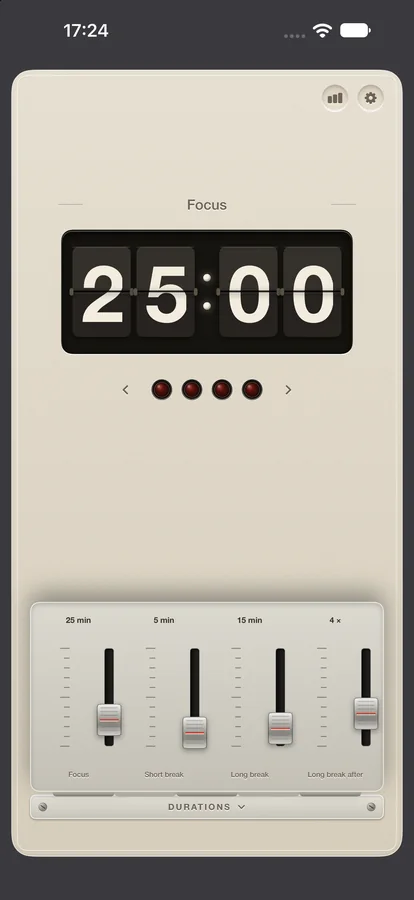
Pomo runs fixed intervals, counted down, with the four lengths set on faders behind the door. The first two variants are a matter of moving the faders. The third is a different instrument.
Common mistakes
- Working through the break. The ring comes while the work is going well, so the break is skipped, and by the third pomodoro the afternoon is gone. Stop at the ring.
- Spending the break on the thing you were avoiding. Five minutes on the phone is rarely five minutes. Stand up instead.
- Splitting a pomodoro. Pausing to answer a message and resuming afterwards. Cirillo's rule is that a pomodoro is indivisible; a paused one is a void one, and the honest thing is to start again.
- Starting without a task. The task comes first, and it should be small enough to see the end of.
- Treating the marks as a score. The count is a record of the day. Chasing a higher number than yesterday's is how the breaks get skipped.
Doing it with Pomo
The appliance follows the six steps part for part. What it adds to a kitchen timer is the record, the sync and, on the Mac, the door.
- 1Choose a taskWrite it on the nameplate above the display. The name goes into the record with the session, so the week's hours are listed by task without further typing.
- 2Set the pomodoroThe faders behind the door marked Durations stand at 25, 5 and 15 out of the box, with a cycle of four. Press the red button; the lamp inside warms up and the display starts to flip.
- 3Work until it ringsThe countdown stays in view, in the menu bar, on the Lock Screen or on the wrist. On the Mac, the apps and websites on the distractions list stay shut until the bell. Commitment mode locks pause and reset, which is Cirillo's indivisibility rule made mechanical.
- 4The check markThe bell rings and a lamp comes on. The session is entered in the record under its title, and the day gets its stamp. The marks on the paper become bars in the record, readable by day, week, month or year.
- 5The short breakThe lamps and the button turn green and the display counts down the five minutes. On the Mac, the fullscreen break option takes over the screen so the break is actually taken.
- 6The long breakAfter the fourth lamp, the long break runs by itself. How many sessions make a cycle is the fourth fader behind the door.
The record syncs through iCloud across Mac, iPhone, iPad and Apple Watch, and can be transferred to Apple Calendar or saved as CSV. All of it is free and needs no account. The owner's manual describes the appliance itself.
Questions about the method
How does the Pomodoro Technique work, in one paragraph?
Choose one task, set a timer for 25 minutes, and work on nothing else until it rings. Take a five-minute break. After four of these, take a longer break of 15 to 30 minutes. Each finished interval gets a check mark, and the marks are your record of the day.
What if I finish the task before the timer rings?
Cirillo's answer is to use the remaining minutes on the same task: read over what was done, tidy it, note what comes next. The pomodoro still has to ring.
Is 25 and 5 scientifically proven?
The lengths are a convention Cirillo settled on with his own timer and kept because they worked. The method's value is in the fixed rhythm and the kept interval, and a reader who prefers 30 and 6 loses nothing.
Does it work for studying?
It was invented for studying. Reading, revision and problem sets divide into pomodoros more naturally than most office work does. The study timer leaflet goes into revision timetables and exams.